
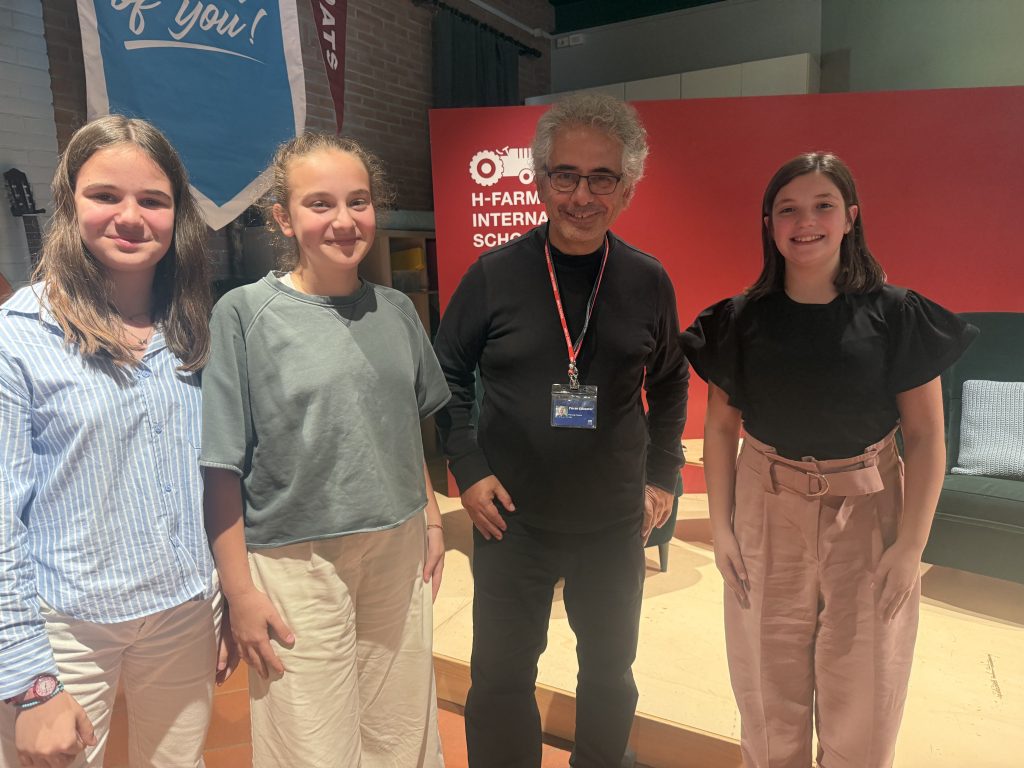
Last week, our school had the pleasure of hosting Professor Pierluigi Fasano, an expert in artificial intelligence and Chief Learning Architect at H-FARM Education.
The meeting offered a broad and thought-provoking perspective on the role of artificial intelligence and the profound transformations that are redefining the way we learn, work, and interpret the future.
At the center of the discussion was the concept of the “Fourth Science”: a new paradigm in which AI is no longer just a technological tool, but becomes an active part of scientific discovery and the modeling of reality.
Among the topics discussed, several key insights emerged for all our Lower Secondary School students:
Acceleration of scientific discovery
From computational biology (such as AlphaFold, capable of analyzing millions of protein structures in unprecedented timeframes) to the design of new materials and complex systems, AI is radically changing the pace of scientific progress.
Energy, space, and future infrastructures
Nuclear fusion, space-based data centers, and new energy technologies open up scenarios in which production, sustainability, and digital infrastructure could be completely reimagined.
Bio-computers and neural intelligence
The use of biological neurons to build computing systems introduces new possibilities in terms of efficiency and learning, but also raises important ethical questions related to consciousness and responsibility.
World models and advanced artificial intelligence
The evolution toward systems capable not only of processing data but also of simulating and understanding the world brings AI closer to forms of reasoning increasingly similar to human cognition.
Ethics and governance of emerging technologies
Innovations in fields such as space, biotechnology, and digital finance raise new questions about regulation, responsibility, and technological control.
The role of new generations
A strong message emerged: the future is not something to wait for, but something to actively build through curiosity, critical thinking, and the ability to navigate non-linear paths.
The meeting also gave space to students’ questions, making the discussion even more concrete and engaging. In particular, a Lower Secondary 3 student, Abramo, stood out for his strong interest and engagement with the topics discussed, so much so that he was invited by Professor Fasano to take part in his next talk.
Abramo also shared a personal reflection:
“In the future, I would like to become an aerospace engineer, so I have always been passionate about the concepts mentioned by Professor Fasano. They are essential to understand how the world is changing and how it will look in the future. It was a valuable opportunity to observe first-hand how quickly the boundaries between science, technology, and society are evolving, and they truly prepare us to face the future… now, I look forward to receiving Professor Fasano’s invitation.”